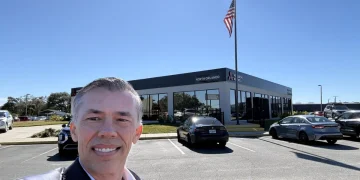


A quiet dealership acquisition in central Florida has given rise to a new automotive group built around a clear and deliberate strategy: used vehicles first. The formation of Marine Automotive Group follows the December purchase of North Orlando Mitsubishi and reflects a broader recalibration underway at many import-brand dealerships, where pre-owned inventory is increasingly the engine of profitability.
The new group is led by U.S. Marine, a longtime dealer-operator who now controls two stores in the Orlando market. Rather than rushing to expand footprint, Marine’s immediate focus is operational, centered on transforming used-vehicle performance at his newly acquired Mitsubishi location and using that momentum to support longer-term growth.
Why Used Vehicles Sit at the Center of the Strategy
Marine’s assessment of opportunity is rooted in experience. He has built strong used-car volume at his Orlando Nissan store, where monthly sales hover around 130 units. By comparison, North Orlando Mitsubishi was previously stocking roughly 30 to 35 used vehicles a month and selling close to that number.
The new plan is significantly more ambitious. Marine intends to scale used inventory to approximately 100 units monthly, with sales targets in the 90 to 100 range. New-vehicle sales remain part of the picture, but at a more modest pace, with expectations of 50 to 60 new units per month.
This imbalance is intentional. For Marine, used vehicles are where operational discipline, pricing strategy, and inventory sourcing can most directly influence margins. It is also where he believes he can quickly differentiate an underperforming store.
A Familiar Playbook for Import Dealers
Industry observers say the approach aligns with what has worked elsewhere. According to Withum, which assisted with the manufacturer approval process for the acquisition, used vehicles often carry outsized importance for Nissan and Mitsubishi retailers.
Jen Moylan, a lead consultant at Withum, has noted that both brands face challenges on the new-car side. Nissan has struggled with market share erosion tied to product mix and past strategic decisions, while Mitsubishi dealers frequently cite an aging lineup and limited model range. In that context, pre-owned sales become a stabilizing force.
The model is not theoretical. Moylan says variations of this used-focused strategy have been deployed successfully by other dealers representing the same brands. In many cases, it becomes a stepping stone, generating cash flow and operational confidence that later supports broader expansion.
Inventory Sourcing and Buying Power
To fuel the ramp-up in used sales, Marine is leaning on multiple sourcing channels. A significant portion of inventory comes from the nearby Manheim auction, supplemented by customer trade-ins and a steady supply of off-rental vehicles.
Owning two dealerships has already improved Marine’s purchasing leverage. With greater volume comes better access to inventory and more flexibility in pricing decisions. As Marine Automotive Group grows, that buying power is expected to strengthen further, improving margins and consistency across stores.
Even without a standalone group website, Marine is already cross-listing used inventory between his dealerships, effectively widening exposure without adding overhead. The tactic reflects a practical, low-friction approach to early-stage group operations.
Selective Growth Rather Than Rapid Expansion
While Marine is open about wanting to acquire additional stores, expansion is not being rushed. He has expressed interest in brands such as Kia, Hyundai, Subaru, and Mazda, though availability remains limited. The next acquisition, he has said, does not need to be a top-performing dealership.
Instead, Marine’s niche lies in identifying underperforming stores and improving results through process discipline and used-vehicle optimization. This philosophy prioritizes operational upside over headline volume and suggests a patient, value-driven growth model for the new group.
From Partnerships to Full Ownership
Marine’s current position as a 100 percent owner marks a significant shift from earlier stages of his career. He previously held interests in multiple Florida dealerships alongside George Sutherlin. After Sutherlin’s passing, ownership transitioned to his son, Brett, and Marine eventually chose to exit those shared ventures.
By selling his equity in two Nissan dealerships and a Mitsubishi store on Florida’s East Coast, Marine generated the capital needed to pursue full ownership. In 2023, he combined those proceeds with bank financing to acquire complete control of the Orlando Nissan store. The decision to retain the Sutherlin name on that location reflects a long professional relationship and personal respect for his former partner.
The Mitsubishi acquisition followed a similar path, though it was funded entirely with cash. The purchase price, just under $7 million, secured a store that had already undergone a facility remodel in mid-2024 and meets current image standards.
Looking Ahead at Brand Potential
Despite Mitsubishi’s limited current lineup, Marine remains optimistic. He points to early signals from the manufacturer suggesting future product introductions that could reinvigorate showroom traffic. While details remain sparse, the expectation is that new models could complement a strong used operation rather than replace it.
For now, the focus remains firmly on execution. By elevating used-vehicle throughput, tightening sourcing, and applying lessons learned at his Nissan store, Marine Automotive Group is positioning itself to grow from a stable base rather than speculative expansion.
In an environment where many dealers are reassessing how to balance new and used operations, the emergence of this Florida-based group underscores a broader reality. For a growing number of dealerships, especially those tied to import brands with constrained lineups, used vehicles are no longer a side business. They are the business.

