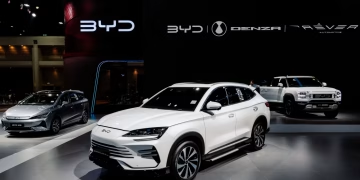


In a significant shift in the electric vehicle (EV) market, Tesla has lost its position as the world’s largest EV manufacturer after a second consecutive year of falling sales. This decline, attributed to factors including a backlash against Elon Musk’s right-wing political stance, the expiration of U.S. tax breaks, and growing competition from overseas rivals, has seen Chinese automaker BYD surge ahead to claim the top spot in global EV sales.
Tesla’s Sales Fall Short in 2025
Tesla’s 2025 sales report revealed a 9% decline in deliveries, dropping to 1.64 million vehicles compared to the previous year. The drop in sales was particularly notable in the fourth quarter, where Tesla fell short of analyst expectations. The company delivered 418,227 vehicles during this period, missing the anticipated 440,000 figure. Tesla executives pointed to the expiration of the $7,500 U.S. tax credit, which phased out in September 2025 under the Trump administration, as a key factor in this drop. The end of this financial incentive led to a slowdown in consumer demand, especially in the U.S. market.
Despite the decline, Tesla’s stock showed a modest increase of 0.5% to $451.60, reflecting investor confidence that CEO Elon Musk can pivot the company towards new ventures beyond traditional car sales. While the immediate outlook for Tesla’s vehicle sales remains uncertain, analysts are betting that Musk’s ambitions in autonomous vehicles, energy storage, and humanoid robots will pay off in the long term.
BYD Surpasses Tesla in Sales
The most significant development in the EV space came when BYD, a Chinese electric vehicle manufacturer, outpaced Tesla with 2.26 million vehicles sold in 2025. This marks a stunning reversal in the EV race, particularly given that Tesla, under Musk’s leadership, once appeared to be an unstoppable force, pushing traditional carmakers to the sidelines while making Musk the world’s richest man.
BYD’s success is attributed to its strong presence in both domestic and international markets, especially in Asia and Europe. Unlike Tesla, which faced price cuts and challenges in key markets, BYD’s diversified approach, including a broader range of EV models, has helped it capture a significant share of the market.
Tesla’s Response: Price Cuts and New Models
In response to its declining sales, Tesla introduced stripped-down versions of its popular Model Y and Model 3 vehicles in October 2025. The new, more affordable versions—priced just under $40,000 for the Model Y and below $37,000 for the Model 3—are part of an effort to regain market share, especially in Europe and Asia, where Chinese EV models are gaining traction. These price reductions are aimed at making Tesla’s vehicles more competitive in an increasingly crowded market, but it remains to be seen whether these moves will drive sustained growth.
Musk’s approach to reviving Tesla’s fortunes also focuses on expanding the company’s business beyond traditional vehicle sales. Tesla has been investing heavily in its driverless robotaxi service, energy storage solutions, and humanoid robots for the home and factory. Musk has repeatedly emphasized that the future of Tesla lies not in cars alone but in these new and emerging technologies. This vision is reflected in the company’s strategic pivot, which has led to some investors overlooking the dip in car sales in favor of future growth potential.
A Shifting Market Landscape
The global EV market is evolving rapidly, and competition is intensifying. Traditional automakers, once slow to adopt electric vehicles, are now stepping up their game with new EV models and technology. Meanwhile, Chinese automakers like BYD have capitalized on government subsidies, a strong domestic market, and early investments in EV infrastructure to outpace Tesla in terms of production and sales.
While Tesla’s brand remains synonymous with electric vehicles, the company faces increasing pressure from competitors who are innovating at a faster pace. Additionally, the rising influence of Chinese companies in the EV space is changing the dynamics of the global market. Tesla, once the undisputed leader, now faces a more complex landscape where its dominance is being challenged on multiple fronts.
The Role of AI and Other Emerging Technologies
Despite its setbacks in the EV market, Musk is betting big on emerging technologies that could reshape the automotive and robotics industries. Tesla’s foray into autonomous vehicles, powered by AI, is a critical part of its strategy to stay ahead of the competition. Musk’s vision of a fleet of autonomous robotaxis could revolutionize transportation, but the technology remains in its infancy and faces regulatory hurdles that may delay its widespread deployment.
In addition to AI-powered vehicles, Tesla is also focusing on its energy storage business, which aims to help both residential and commercial customers manage and store renewable energy more efficiently. The company’s investment in renewable energy solutions aligns with broader global goals for sustainability and could provide Tesla with a new revenue stream as the world transitions to cleaner energy.
Moreover, Musk’s interest in humanoid robots adds another layer to Tesla’s future prospects. These robots are designed to perform basic tasks in homes and offices, and while the concept is still in development, Musk believes that they will play a significant role in shaping the future of work and society.
Investor Confidence Amidst Declining Sales
Despite Tesla’s challenges in the vehicle market, investor confidence in Musk’s ability to deliver on his broader vision remains strong. Tesla’s stock finished 2025 with an approximate 11% gain, indicating that investors are betting on the long-term potential of the company, even as short-term car sales decline. This optimism is largely driven by Musk’s track record of turning ambitious ideas into reality, and the belief that the company’s new ventures, particularly in AI and robotics, will eventually outweigh the challenges in the EV market.
The Road Ahead for Tesla and the EV Industry
As Tesla navigates its current challenges, the company’s focus on innovation and expansion into new areas beyond car sales will likely determine its future trajectory. The rise of competitors like BYD and the intensifying global demand for electric vehicles mean that Tesla must continue to evolve and adapt to stay relevant in an increasingly crowded market. However, with Musk at the helm and a strategic pivot towards AI, energy storage, and robotics, Tesla’s future could still be brighter than its current car sales numbers suggest.
The next few years will be critical for Tesla as it looks to redefine its role in the global economy and stay ahead of the competition. Whether or not Musk can deliver on his ambitious promises will be a key factor in determining whether Tesla can reclaim its leadership position or if new players, such as BYD, will dominate the EV market in the years to come.