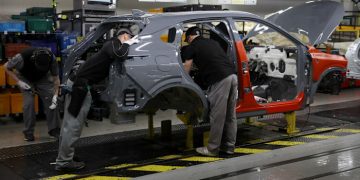


The Nissan Chery partnership under discussion could reshape the future of UK car manufacturing, as both companies explore ways to maximize output at Nissan’s Sunderland plant. According to a Financial Times report, the talks signal a broader shift in how global automakers are approaching capacity, cost efficiency, and electric vehicle production.
At the center of the discussions is a practical challenge. Nissan’s Sunderland facility, one of the UK’s most significant automotive hubs, is currently operating at roughly 50 percent capacity. For a plant designed to produce hundreds of thousands of vehicles annually, that gap represents both a financial burden and an opportunity.
A strategic response to underutilization
The proposed Nissan Chery partnership reflects a pragmatic response to underused infrastructure. Sunderland’s layout, which includes separate production lines across different buildings, allows for operational flexibility. This makes it easier for multiple manufacturers to share space, resources, and even supply chains without major structural changes.
Executives familiar with the discussions say Nissan has already explored similar arrangements with several global automakers. Companies such as Ford, Stellantis, and Volkswagen have reportedly engaged in talks over the past year. While none of these conversations have yet resulted in a confirmed deal, they highlight a growing industry trend toward collaboration rather than duplication.
For Nissan, the stakes are high. The company employs around 6,000 workers at Sunderland, making it one of the largest automotive employers in the United Kingdom. Maintaining stable production levels is critical not only for the company’s balance sheet but also for regional economic stability.
Electric vehicles driving renewed momentum
Recent product launches have provided a partial lift. The introduction of the new Leaf electric vehicle has already improved the plant’s utilization rate, which had previously fallen below 30 percent. This rebound underscores how electrification is becoming a central pillar of Nissan’s manufacturing strategy.
The upcoming electric version of the Juke, scheduled for release in 2027, is expected to further strengthen production volumes. However, analysts caution that these gains alone may not fully address long-term capacity concerns.
Industry observers point to the Nissan Chery partnership as a potential bridge between current production realities and future demand. By sharing manufacturing space, Nissan could reduce fixed costs while Chery gains a foothold in one of Europe’s most competitive automotive markets.
Chery’s global expansion strategy
For Chery, the talks align with a broader international push. The Chinese automaker has rapidly expanded its presence outside domestic markets, focusing on localized production to avoid tariffs and improve supply chain resilience.
Earlier this year, Chery agreed to acquire Nissan’s manufacturing plant in Rosslyn, South Africa. The deal, expected to close in mid-2026, includes land, buildings, and stamping facilities. Importantly, Chery has committed to retaining most of the existing workforce under similar compensation structures.
The company has also taken control of a former Nissan plant in Barcelona, Spain, further strengthening its European manufacturing footprint. These moves suggest that the Nissan Chery partnership in the UK would not be an isolated initiative but part of a coordinated global strategy.
Chery’s growth trajectory in the UK adds another layer of relevance. The company’s market share rose to approximately 6 percent in March, up sharply from just 1 percent a year earlier. That pace of expansion positions Chery as one of the fastest-growing automotive brands in the country.
Uncertainty remains despite strong rationale
Despite the apparent strategic fit, insiders caution that the Nissan Chery partnership is far from guaranteed. Negotiations in the automotive sector are often complex, involving regulatory considerations, labor agreements, and long-term investment commitments.
Two individuals familiar with the matter told the Financial Times that the discussions may not ultimately lead to a commercial agreement. Competing interests, shifting market conditions, or internal restructuring priorities could all influence the outcome.
Nissan’s broader corporate strategy adds further uncertainty. The company is currently undergoing a sweeping global restructuring program that includes the potential closure of multiple manufacturing sites and the elimination of up to 20,000 jobs worldwide. Details of this plan have been reported by outlets such as Financial Times and are being closely monitored by investors and policymakers alike.
In this context, any decision regarding Sunderland will be evaluated against global cost structures and future demand forecasts for electric vehicles.
Industry shift toward shared manufacturing
The discussions also reflect a wider transformation within the automotive industry. As electrification accelerates and margins tighten, manufacturers are increasingly reconsidering how they deploy capital-intensive assets like factories.
Shared production models, once rare, are gaining traction. By collaborating, companies can reduce duplication, optimize supply chains, and respond more flexibly to market demand. Analysts at International Energy Agency have noted that EV adoption is pushing automakers to rethink traditional manufacturing models, particularly in mature markets like Europe.
For the UK, the implications extend beyond a single plant. Securing long-term investment in Sunderland would reinforce the country’s position as a key player in the transition to electric mobility. It would also send a positive signal at a time when the sector faces uncertainty related to trade policies, supply chains, and technological shifts.
What comes next
The future of the Nissan Chery partnership will likely hinge on timing and alignment. Nissan needs to stabilize its global operations while preserving strategic assets like Sunderland. Chery, meanwhile, is seeking rapid expansion without the delays associated with building new facilities from scratch.
If the two companies can align their objectives, the partnership could offer mutual benefits. Nissan would improve plant utilization and reduce costs, while Chery would gain immediate access to UK manufacturing capacity and a stronger European presence.
For now, the talks remain exploratory. Yet even at this stage, they highlight a critical truth about the modern automotive industry. Flexibility, collaboration, and strategic partnerships are no longer optional. They are becoming essential tools for survival in a rapidly evolving market.