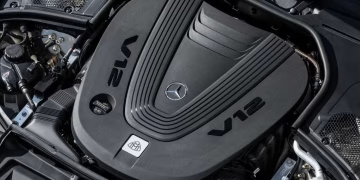


Mercedes V12 discontinuation becomes official across European Union markets. Consequently, the twin-turbo 6.0-liter unit exits the Old Continent. Moreover, stricter emissions regulations drive this strategic decision. Therefore, the M 279 engine reaches its regional endpoint. Specifically, Euro 7 standards prove incompatible with twelve-cylinder design.
A company spokesperson confirmed this change to Motor1 recently. Furthermore, countries aligning with European Certificate of Conformity also lose this engine. Iceland, Liechtenstein, and Norway follow the EU directive accordingly. Additionally, India and other regions bid farewell to this decade-old powerhouse. Hence, Mercedes V12 discontinuation reflects global regulatory convergence.
Mercedes-Benz maintains clear ambition for customer satisfaction consistently. Specifically, all Mercedes-Maybach models must meet highest demands. Therefore, the company constantly evolves its portfolio strategically. Moreover, regular reviews address specific market requirements effectively. Accordingly, meticulous compliance with EU7 standards remains non-negotiable. Thus, Mercedes V12 discontinuation aligns with brand evolution goals.
The updated V8 becomes the new top engine specifically. Consequently, it delivers extraordinary 450 kW or 603 horsepower. Furthermore, this performance matches the current V12 output exactly. Therefore, driving comfort remains worthy of Maybach standards consistently. Hence, Mercedes V12 discontinuation does not compromise luxury experience.
V12 availability continues in select global markets strategically. Specifically, China, the United States, and Middle East retain the engine. Moreover, the S680 nameplate remains consistent globally. Therefore, regional variations reflect regulatory differences rather than branding changes. Accordingly, eight-cylinder versions now match twelve-cylinder power outputs. Thus, Mercedes V12 discontinuation affects only specific territories.
The U.S. S680 maintains a slight performance advantage currently. Specifically, its V12 produces 621 horsepower total. Furthermore, 664 pound-feet of torque provide meaningful acceleration benefits. Consequently, the twelve-cylinder variant retains enthusiast appeal significantly. Hence, Mercedes V12 discontinuation creates regional product differentiation.
Prestige remains a crucial factor for twelve-cylinder sedans. Specifically, few competitors offer this configuration in 2026. Moreover, Bentley discontinued its W12 Flying Spur recently. Additionally, Volkswagen Phaeton and Audi A8 W12 models are historical. BMW retired its V12 with the previous 7 Series generation. Therefore, Mercedes V12 discontinuation reduces luxury segment options.
Rolls-Royce continues V12 usage in Ghost and Phantom models. Consequently, ultra-luxury buyers retain twelve-cylinder choices selectively. However, Mercedes-Maybach occupies a distinct market position strategically. Therefore, pricing strategy reflects both scarcity and brand positioning. Hence, Mercedes V12 discontinuation may enhance exclusivity perception.
Pricing details remain unavailable for the updated Maybach S680. Specifically, predecessor models started at $245,750 in the United States. Furthermore, twelve-cylinder sedan scarcity may support premium valuation. Consequently, final pricing likely exceeds quarter-million dollar threshold. Therefore, Mercedes V12 discontinuation influences residual value dynamics.
Euro 7 legislation drives this strategic portfolio adjustment significantly. Consequently, larger engines face heightened compliance challenges consistently. Moreover, electrification represents the primary pathway for future powertrains. Therefore, investing in complex hybrid V12 systems lacks economic rationale. Hence, Mercedes V12 discontinuation reflects pragmatic engineering decisions.
The Maybach S-Class represents a niche luxury product specifically. Consequently, development resources prioritize high-volume powertrain architectures strategically. Furthermore, regulatory complexity increases with each additional engine variant. Therefore, portfolio simplification supports long-term brand sustainability. Thus, Mercedes V12 discontinuation enables focused innovation investment.
Mercedes-Benz produces additional V12 units beyond the M 279. Specifically, the AMG subsidiary previously offered 65-badged performance models. Moreover, Pagani Utopia utilizes the M 158 unit from Affalterbach. Consequently, twelve-cylinder expertise remains within the corporate ecosystem. Hence, Mercedes V12 discontinuation affects only specific applications.
Consumer sentiment influences luxury automotive purchasing decisions significantly. Consequently, enthusiast demand for twelve-cylinder engines remains resilient. Moreover, emotional appeal often outweighs pure efficiency metrics. Therefore, regional availability strategies must balance regulation with desire. Accordingly, Mercedes V12 discontinuation requires careful market communication.
Environmental policy shapes automotive development trajectories globally. Specifically, emissions standards drive technological innovation consistently. Furthermore, electrification timelines accelerate across major markets. Consequently, internal combustion evolution faces increasing constraints. Hence, Mercedes V12 discontinuation reflects broader industry transition.
The luxury sedan segment experiences continuous transformation currently. Consequently, manufacturers adapt product portfolios to regulatory realities. Moreover, consumer expectations evolve alongside technological capabilities. Therefore, strategic agility determines competitive positioning. Thus, Mercedes V12 discontinuation demonstrates responsive brand management.
Looking ahead, powertrain diversification remains essential for luxury brands. Specifically, hybrid and electric architectures require substantial investment. Furthermore, customer education supports technology adoption effectively. Consequently, communication strategies must emphasize performance and sustainability. Hence, Mercedes V12 discontinuation initiates broader product evolution.
The trajectory of Mercedes V12 discontinuation signals regulatory impact. Consequently, traditional powertrain configurations face increasing constraints. Moreover, innovation focus shifts toward electrified solutions. Therefore, engineering resources reallocate toward future mobility. Thus, Mercedes V12 discontinuation accelerates technological transition.
Ultimately, brand heritage balances with regulatory compliance strategically. Specifically, Mercedes-Maybach maintains luxury leadership through adaptation. Moreover, customer satisfaction remains the primary success metric. Consequently, product evolution supports long-term brand equity. Hence, Mercedes V12 discontinuation enables sustainable growth. Therefore, stakeholders monitor market response closely. Additionally, competitive dynamics influence strategic decisions.