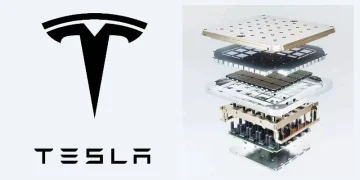


Elon Musk announced on Thursday that Tesla might finalize the design of its next-generation AI6 chips as early as December. This milestone, known in the industry as “taping out,” marks the moment when engineers lock a chip design and send it to a foundry for production. The CEO made the statement on his social media platform, X, and expressed cautious optimism about the timeline. Consequently, this development signals a major step forward for Tesla’s artificial intelligence ambitions.
Musk previously confirmed that Samsung Electronics would manufacture these advanced processors. The South Korean tech giant secured a massive $16.5 billion deal to supply artificial intelligence chips to the electric vehicle maker last year. Production will take place at Samsung’s new facility in Taylor, Texas. These AI6 chips will power Tesla’s future self-driving cars and humanoid robots. Therefore, the successful taping out of the design serves as a prerequisite for the entire project.
“With some luck and acceleration using AI, we might be able to tape out AI6 in December,” Musk stated. His comment suggests that Tesla is leveraging its own artificial intelligence tools to speed up the design process. This approach could significantly compress the traditional development cycle. However, the CEO also acknowledged the role of fortune in meeting such an aggressive deadline. Nevertheless, the target date underscores Tesla’s urgency to dominate the autonomous hardware market.
A Samsung executive provided further context on Wednesday regarding the manufacturing schedule. The company plans to produce the Tesla chips using its advanced 2-nanometer process. Production is expected to begin in the second half of 2027. This timeline indicates a gap between the design finalization and mass availability. Yet, securing a spot on Samsung’s cutting-edge node represents a strategic victory for Tesla. It ensures access to some of the most powerful and efficient silicon available globally.
The AI6 chips represent a significant leap in computational power for Tesla vehicles. Current models rely on previous generations of hardware to process data from cameras and sensors. The new architecture will likely handle more complex neural networks required for full self-driving capabilities. Moreover, these chips will serve as the “brain” for the Optimus humanoid robot. As Tesla expands beyond automobiles, the demand for high-performance inference chips grows exponentially.
Samsung’s involvement highlights the intensifying competition in the semiconductor sector. The Taylor, Texas factory stands as a cornerstone of the company’s strategy to expand its foundry business outside of Asia. By partnering with Tesla, Samsung strengthens its position against rivals like TSMC. Furthermore, localizing production in Texas aligns with US government incentives aimed at boosting domestic chip manufacturing. This collaboration benefits both companies and the broader American tech ecosystem.
The road from tape-out to volume production remains challenging. Once the team finalizes the design, engineers must create masks and prepare the fabrication lines. Yield rates often fluctuate during the initial phases of a new process node. The 2-nanometer technology presents particular complexity and remains unproven at scale. Therefore, any delays in the manufacturing phase could push back the deployment of AI6 chips in consumer vehicles. Investors and analysts will watch the progress closely throughout 2027.
Tesla’s reliance on custom silicon distinguishes it from many legacy automakers. Most competitors purchase off-the-shelf components from suppliers. In contrast, Tesla designs its own hardware to optimize performance for its specific software stack. This vertical integration allows for tighter control over costs and capabilities. The AI6 chips are the latest example of this philosophy in action. Engineers tailored them specifically for the unique demands of Tesla’s Autopilot and Full Self-Driving systems.
The implications for the robotics sector are equally profound. Humanoid robots require immense processing power to navigate dynamic environments safely. The efficiency of the 2-nanometer process will be crucial for managing heat and power consumption in mobile robots. If Tesla can deliver these chips on schedule, it may accelerate the commercial viability of Optimus. Consequently, the December tape-out target is not just about cars; it is about the future of robotics.
Market reaction to Musk’s announcement has been mixed. Some investors view the timeline as ambitious but achievable given Tesla’s track record. Others worry that relying on “luck” introduces unnecessary risk. Semiconductor projects frequently face unforeseen technical hurdles. Despite these concerns, the partnership with Samsung provides a solid foundation. The financial commitment from both parties demonstrates a shared belief in the project’s success.
As the industry awaits further updates, the focus shifts to the execution phase. Tesla’s engineering teams must now race against the clock to finalize the design. Simultaneously, Samsung must ensure its Texas facility is ready for the 2027 production ramp-up. The successful delivery of AI6 chips could redefine the landscape of autonomous transportation. It would also validate Tesla’s strategy of in-house chip development.