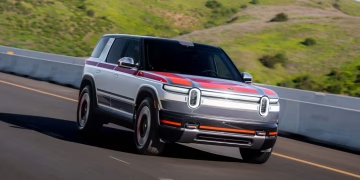


Rivian, the California-based electric vehicle startup, is making strides toward expanding its lineup with the highly anticipated launch of the R2, a compact electric SUV that could become the cornerstone of the company’s future success. After unveiling the R2 in 2024, Rivian is ready to kick off production in the second quarter of 2026. However, while initial production will begin this spring, the company plans to gradually ramp up its manufacturing process throughout the year, with volume production expected to reach full capacity by the latter half of 2026.
Rivian’s Production Strategy for the R2
The R2 marks a significant milestone in Rivian’s expansion plans, as it aims to capture a larger share of the electric vehicle market, particularly targeting budget-conscious consumers. The production of this smaller, more affordable electric SUV will be crucial for the company’s long-term growth. As Rivian CEO RJ Scaringe noted, the R2 is expected to make up the majority of the company’s sales by 2027.
The production of the R2 will begin in the second quarter of 2026 at Rivian’s factory in Normal, Illinois. However, as is common with new product launches, the company anticipates a gradual ramp-up in production capacity. Initially, Rivian will operate with one production shift at its Normal facility for the R2, but this will be expanded later in the year as the company works to meet demand. Rivian’s factory has been expanded to accommodate up to 215,000 vehicles annually, including 155,000 units of the R2. This is part of the company’s strategy to build a sustainable production pipeline as the R2 becomes central to its sales objectives.
Sales Projections for 2026 and Beyond
Despite the anticipated gradual increase in production, Rivian is optimistic about its ability to deliver a significant number of R2 units in 2026. The company is projecting between 20,000 and 25,000 deliveries of the R2 in its first year of production, a figure that represents a modest but promising start for the new model. Rivian expects its other models, including the R1S, R1T, and commercial van, to maintain sales figures similar to those in 2025, with total vehicle deliveries ranging from 62,000 to 67,000 units across its entire lineup.
While these sales projections for 2026 are relatively conservative, they reflect the challenges that come with launching a new vehicle, particularly for a company that is still scaling its production capabilities. The R2’s base price is expected to start around $45,000, making it Rivian’s most affordable offering, but the company has yet to release official pricing details for the initial launch edition models. These will likely be priced higher, reflecting the premium features that will be available at launch.
The R2’s Features and Specs
The Rivian R2 is expected to be a game-changer for the company, offering a compact, versatile SUV that combines performance, range, and affordability. Rivian plans to offer the R2 with a range of configurations, including a dual-motor powertrain that will produce 656 horsepower and offer approximately 300 miles of range on a single charge. In addition to the base dual-motor setup, Rivian has also announced that single-motor and performance-oriented tri-motor models will be available, catering to different customer preferences for power and driving dynamics.
The R2’s compact size and advanced electric powertrain are designed to make it an attractive option for a wide range of consumers, particularly those looking for a more affordable alternative to larger electric SUVs. The dual-motor model, in particular, promises a balance of performance and efficiency, while the tri-motor performance variant will appeal to those seeking a more exhilarating driving experience.
One of the key selling points of the R2 will be its affordability relative to other electric SUVs in the market. By starting at a base price of $45,000, the R2 will compete with other budget-friendly electric models, offering consumers a more accessible entry point into the world of electric vehicles. Rivian’s ability to balance cost with performance and range will be critical to its success in capturing a broader market segment.
Rivian’s Expansion Plans
In addition to expanding production in Illinois, Rivian is also looking ahead to the future with plans to build a new plant in Georgia. This new facility will be crucial for ramping up production of the R2 and other future models, allowing Rivian to meet the growing demand for electric vehicles across the United States. As the company continues to grow, it will need to scale its manufacturing capacity to keep pace with increasing consumer interest in electric vehicles.
The introduction of the R2 is part of Rivian’s larger strategy to expand its global footprint. The company has already made a name for itself with its R1S and R1T models, which have received praise for their rugged design, performance, and sustainability features. However, the R2 represents the company’s push into the mainstream market, targeting customers who may not have been able to afford the higher-priced R1 models.
Rivian’s expansion into new markets, coupled with its aggressive production plans for the R2, shows that the company is positioning itself as a serious contender in the competitive electric vehicle market. As more automakers introduce electric models, Rivian will need to differentiate itself by offering a compelling combination of price, performance, and innovation.
Rivian’s Long-Term Vision
Looking ahead, Rivian’s long-term vision hinges on the success of the R2. As the company moves toward its goal of reaching over 100 million daily active customers by 2027, the R2 is expected to be a key driver of growth. Rivian’s leadership in electric trucks and SUVs has already established the company as a major player in the EV market, but the R2 represents the next step in its journey to becoming a household name in the world of electric mobility.
With the R2 expected to make up the majority of Rivian’s sales by the end of 2027, the company’s focus will be on scaling production, enhancing its supply chain, and expanding its global presence. As electric vehicles become more mainstream, Rivian is positioning itself to lead the charge, offering consumers a wide range of options at different price points and performance levels.
The success of the R2 will also be crucial for Rivian’s ability to remain competitive in an increasingly crowded market. As other automakers ramp up their electric vehicle offerings, Rivian’s ability to deliver high-quality, affordable models like the R2 will determine whether the company can maintain its momentum and continue to grow in the coming years.

