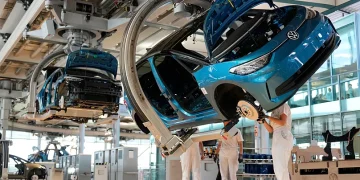


Europe auto overcapacity is becoming one of the biggest challenges facing the region’s automotive industry. Many car factories across Europe are operating far below their production limits, raising difficult questions for automakers about the future of their manufacturing networks.
The Europe auto overcapacity problem reflects weakening demand, changing market dynamics, and the rapid rise of global competition. While closing factories could help companies cut costs, the political and labor consequences make those decisions extremely difficult for automakers.
Europe auto overcapacity leaves factories underused
The Europe auto overcapacity crisis has left many production plants operating at only a fraction of their potential output. Several facilities are currently running far below the levels needed to remain economically efficient.
For example, some factories in Europe are producing vehicles at less than one-third of their designed capacity. When production falls this low, manufacturing costs rise sharply because companies must maintain facilities, workers, and supply chains even when fewer vehicles are being built.
Automakers face a difficult choice. Keeping underused plants open drains financial resources. However, shutting them down risks political backlash and labor unrest.
Europe auto overcapacity creates political challenges
Europe auto overcapacity is not only an economic problem but also a political one. Factory closures can trigger fierce resistance from labor unions and local governments that depend on auto jobs.
Many European car plants employ thousands of workers and support entire regional economies. When automakers consider closing facilities, politicians often intervene to protect employment.
As a result, companies sometimes continue operating plants even when they are no longer financially viable. This prolongs the auto overcapacity issue and makes it harder for manufacturers to adjust production to match market demand.
Chinese solutions to Europe auto overcapacity face obstacles
Some industry analysts believe Chinese automakers could help address Europe auto overcapacity by forming partnerships with European manufacturers. Chinese companies are rapidly expanding their presence in global auto markets and may seek production capacity in Europe.
However, this approach faces significant challenges. Political concerns about foreign ownership, technology transfers, and supply chain security could slow such collaborations.
European governments remain cautious about allowing Chinese companies to gain deeper control over strategic industries. As a result, efforts to use Chinese partnerships to ease the auto overcapacity problem may face regulatory hurdles.
Changing market conditions worsen Europe auto overcapacity
The auto overcapacity problem has been building for years. Several major shifts in the global automotive market have contributed to the current situation.
First, the transition to electric vehicles requires different production processes and supply chains. Some older factories designed for combustion engine vehicles struggle to adapt to EV production.
Second, global competition has intensified. Chinese automakers, in particular, are rapidly expanding into international markets with competitively priced electric vehicles.
Third, demand patterns have changed. Consumer preferences are shifting toward SUVs and electric models, leaving some traditional production lines underutilized.
Together, these trends have left many European plants struggling to maintain full production schedules.
Automakers face difficult decisions ahead
Solving the auto overcapacity crisis will likely require major structural changes across the industry. Automakers may need to consolidate production, modernize factories, or shift manufacturing strategies.
Some companies are exploring partnerships with global competitors to share production capacity and reduce costs. Others are investing in advanced technology to make factories more flexible.
Still, any solution must balance economic efficiency with political realities. Governments and labor unions will play a significant role in shaping the outcome.
Future of Europe’s automotive industry
The Europe auto overcapacity issue highlights the broader transformation underway in the global automotive sector. As electric vehicles, automation, and new competitors reshape the industry, traditional manufacturing models are being challenged.
European automakers must adapt quickly if they want to remain competitive in a rapidly evolving market. The choices they make in response to Europe auto overcapacity will likely determine the future structure of the region’s automotive industry.