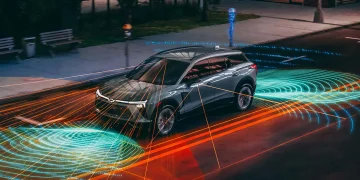


GM Road Condition Technology may soon help drivers avoid potholes and broken roads before they even see them. General Motors recently filed a patent for an advanced system that uses vehicle sensors, cameras, GPS, and cloud connectivity to track road quality in real time. It’s a bold move to improve driving safety, comfort, and potentially reduce costly repairs.
The new patent—filed on December 15, 2023, and published publicly on June 19, 2025—bears the number US 2025/0200526 A1. It outlines a smart system that scans road surfaces as vehicles move. The tech monitors suspension movement, wheel rotation, and vibration to detect pavement problems like potholes or uneven surfaces. GM plans to use onboard cameras to visualize these imperfections and share them through cloud-based networks using GPS and telematics.
From this data, GM’s system generates a Road Maintenance Score, reflecting the condition of the roadway. If the score drops below a certain level, the system could notify city or state officials and suggest maintenance. The vehicle could also recommend alternate routes for drivers if it detects unsafe or deteriorating road segments ahead.
This kind of GM Road Condition Technology could integrate seamlessly with Super Cruise, GM’s hands-free driving system. With Super Cruise already covering 750,000 miles across North America, the potential for route rerouting and predictive safety alerts could enhance autonomous driving performance and reduce vehicle wear.
The implications are wide-reaching. American roads are notoriously inconsistent, with the American Society of Civil Engineers (ASCE) rating the national infrastructure a “C” in its 2025 report. The grade, though slightly improved thanks to President Biden’s $1 trillion infrastructure bill passed in 2021, still points to an ongoing need for smarter solutions. ASCE’s Darren Olson explained that infrastructure investment boosts economic competitiveness—but more work remains.
GM Road Condition Technology takes a proactive role. By collecting and sharing real-time road data, it empowers both drivers and public agencies. Motorists gain insight and avoid damage, while municipalities receive detailed location-specific alerts for rapid response. As this data accumulates, cities could create predictive maintenance models, reducing long-term costs.
This isn’t GM’s only tech-forward patent. In 2023, the company filed a separate application for a “Vehicle Occupant Mental Wellbeing Assessment” system. This design would monitor driver behavior and deploy countermeasures during emotional distress—possibly preventing road rage incidents. Another patent focused on headlight glare reduction using an augmented-reality auto-dimming windshield.
Although GM hasn’t been granted patents for these ideas yet, they reflect a broader trend. Automakers are moving beyond basic performance to explore smart mobility solutions. These innovations tackle everyday frustrations like bad roads, stress behind the wheel, and night-time glare—factors that directly affect driver experience.
If implemented, GM Road Condition Technology could become a game-changer for urban and rural driving alike. Roads with poor drainage, recurring potholes, or seasonal frost heaving could be tracked more accurately. Drivers might finally avoid the costly surprises that lie beneath puddles or shaded curves.
For now, these systems remain in development. But the technology shows promise. With America’s road network stretching across millions of miles, a vehicle-based detection system might prove more efficient than manual inspections. By turning cars into rolling sensors, GM could modernize road management at scale.
Whether this tech arrives in the next generation of GM vehicles or takes more time, one thing is clear: GM Road Condition Technology is aimed at making roads safer and smarter—for everyone.

