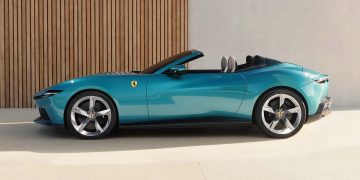


The Ferrari Amalfi Spider arrives as the latest open-top grand tourer from Ferrari, combining V8 performance with a convertible design engineered for both elegance and speed. By removing the coupe’s fixed roof and replacing it with a refined soft top, Ferrari transforms the car into a machine designed to deliver a more immersive driving experience.
For decades, Ferrari has treated open-roof models as milestones in its lineup. The Ferrari Amalfi Spider continues that tradition. It introduces a 2+ convertible configuration that allows drivers and passengers to experience the sound and character of a Ferrari V8 with the roof fully lowered.
At first glance, the design focuses on balance and proportion. Developed by the Ferrari Design Studio, the Ferrari Amalfi Spider is intended to remain visually striking regardless of roof position. With the roof closed, the silhouette closely mirrors the coupe’s sleek lines. However, once the soft top retracts, the car takes on a more expressive profile that emphasizes its sculpted bodywork.
Light and shadow play across the car’s clean surfaces, giving the exterior a refined but modern appearance. At the center of this transformation sits the soft roof itself. Ferrari engineered the roof with a five-layer fabric structure arranged in a layered “sandwich” format. As a result, the system helps reduce external noise and improves cabin comfort while maintaining the flexibility of a convertible top.
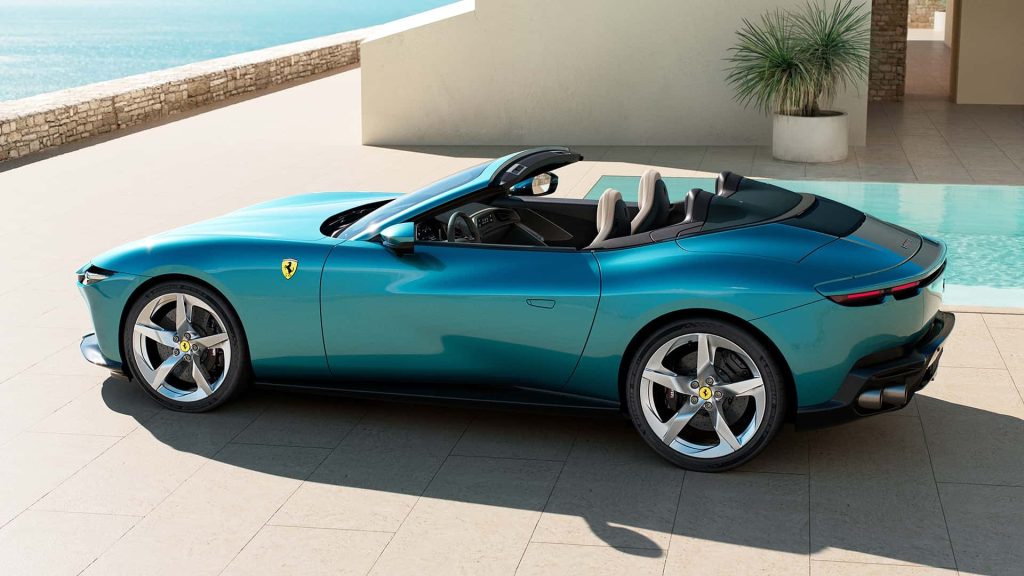
The roof design also integrates a rear window and offers multiple customization choices. Buyers can select from four fabric colors along with two technical-fabric options. Among these is the newly introduced Tecnico Ottanio material, which blends technical durability with visual depth. Notably, the same fabric weave can extend across the tonneau cover and nearby body surfaces, ensuring visual continuity throughout the vehicle.
Beyond design, Ferrari placed strong emphasis on aerodynamics. The Ferrari Amalfi Spider underwent extensive airflow development to maintain stability at high speeds. At the rear, the car features an integrated active wing with three operational positions. When set to High Downforce mode, the wing can generate up to 243 pounds of downforce at 155 miles per hour. Consequently, the system helps balance stability and efficiency during high-speed driving.
Passenger comfort also shaped several elements of the car’s design. Driving with the roof down often introduces wind turbulence. To address this, Ferrari integrated a wind deflector into the rear seat backrest. The system reduces airflow disturbance inside the cabin. Moreover, drivers can deploy it electronically with a simple button press. When not required, the deflector folds back neatly into its housing.
Inside the cabin, Ferrari pursued a minimalist yet refined aesthetic. The center tunnel takes the form of a suspended aluminum bridge that divides the cockpit. Meanwhile, the door panels feature subtle design references inspired by nautical craftsmanship. Together, these elements create an interior that blends sportiness with understated elegance.
The instrument cluster sits within a monolithic cockpit structure that also integrates the air vents. In addition, two supplementary displays handle infotainment functions and passenger interaction. This layout keeps the driver’s focus centered on the road while still delivering modern digital functionality.
Practical considerations also shaped the design. The folded soft roof measures about 220 millimeters thick. Consequently, luggage space changes depending on roof position. With the roof closed, cargo capacity reaches approximately 9.0 cubic feet. However, lowering the roof reduces available storage to around 6.1 cubic feet.
Performance remains the defining characteristic of the Ferrari Amalfi Spider. Power comes from a twin-turbocharged 3.9-liter V8 engine producing 631 horsepower. The engine belongs to Ferrari’s renowned F154 family, known for combining high output with refined response. In this application, it achieves a specific output of 163 horsepower per liter.
Engine updates contribute to efficiency and durability. Engineers introduced a revised turbocharging system and lightweight camshafts that reduce engine weight by nearly three pounds. Additionally, Ferrari redesigned parts of the engine block using precision machining techniques to optimize mass distribution and thermal performance.
The Ferrari Amalfi Spider also incorporates advanced drivetrain technology. Power flows through an eight-speed wet-clutch dual-clutch transmission, the same unit used in the SF90 Stradale. As a result, gear changes occur rapidly while maintaining smooth power delivery.
Vehicle dynamics systems further enhance control. The car features the latest version of Ferrari’s Side Slip Control system. This technology coordinates steering response, torque management, and vertical body control. Consequently, it helps drivers maintain stability even when pushing the car toward its performance limits.
Driving modes remain adjustable through Ferrari’s well-known Manettino switch. The system offers five modes: Wet, Comfort, Sport, Race, and ESC-Off. Each setting adjusts parameters such as traction control, suspension damping, and electronic differential behavior.
Modern safety and assistance systems also appear in the Ferrari Amalfi Spider. Standard equipment includes adaptive cruise control, automatic emergency braking, blind spot detection, lane departure warning, and lane keeping assistance. Additionally, the vehicle provides traffic sign recognition and driver attention monitoring. Optional technologies include surround-view cameras and rear cross-traffic alerts.
Pricing places the Ferrari Amalfi Spider firmly in the upper tier of the luxury sports car market. The coupe version of the Amalfi begins at roughly €240,000 in Europe. However, the convertible variant commands a higher entry point. The Ferrari Amalfi Spider starts at approximately €270,000.
Ferrari has already opened order books for the model. According to the company, initial deliveries are expected in early 2027. Until then, the Ferrari Amalfi Spider stands as a clear expression of Ferrari’s philosophy. By combining performance engineering with open-air design, the car aims to deliver both speed and sensory excitement in equal measure.

