

The Japan robotaxi market is rapidly gaining global attention as major technology and automotive companies race to launch autonomous ride services. New partnerships involving Nissan, Uber, and AI firm Wayve are positioning Japan as one of the most important testing grounds for next-generation self-driving transport.
Experts say the Japan robotaxi market is attracting global players because of the country’s large taxi industry and a growing shortage of professional drivers. As mobility companies search for real-world deployment opportunities, Japan’s urban transport system offers an ideal environment for autonomous vehicle trials.
Japan robotaxi market attracts global technology companies
The Japan robotaxi market is quickly becoming a competitive arena for autonomous mobility innovation. Several global technology firms and automakers are now forming partnerships to develop and deploy self-driving taxi services across the country.
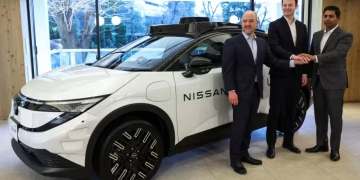
One of the most prominent collaborations involves Nissan, ride-hailing giant Uber, and artificial intelligence developer Wayve. The companies plan to jointly develop a robotaxi based on the Nissan Leaf electric vehicle and deploy it in Tokyo before the end of the year.
The partnership highlights how traditional automakers and tech companies are combining expertise to accelerate autonomous driving technology. Automakers provide the vehicles and manufacturing capability, while technology firms contribute advanced software and AI systems.
Driver shortages fuel Japan robotaxi market growth
A major factor accelerating the Japan robotaxi market is the country’s growing shortage of taxi drivers. Japan’s aging population has created a labor gap in several sectors, including transportation.
Taxi companies have struggled to recruit enough drivers to meet rising demand in major cities. This challenge is pushing both public officials and private companies to explore autonomous mobility solutions.
Robotaxis could help fill the gap by operating continuously without requiring human drivers. As a result, policymakers and mobility firms see autonomous vehicles as a long-term solution to transportation workforce shortages.
Tokyo emerges as key testing ground
Tokyo is expected to become the first major hub for the Japan robotaxi market rollout. The city’s dense urban environment and well-developed infrastructure make it ideal for testing advanced mobility technology.
The Nissan, Uber, and Wayve partnership aims to launch a robotaxi service using the Nissan Leaf electric vehicle platform. The goal is to deploy these vehicles in Tokyo before the end of the year.
Executives involved in the project say the collaboration combines Nissan’s vehicle engineering with Wayve’s artificial intelligence driving system and Uber’s global mobility platform.
If successful, the Tokyo deployment could open the door for broader expansion of robotaxi services across Japan.
Autonomous startups join Japan robotaxi market race
The Japan robotaxi market is not limited to the Nissan partnership. Autonomous technology company Nuro is also testing self-driving vehicles in the country.
Nuro has been conducting trials focused on autonomous delivery and mobility technologies. Its presence in Japan signals growing international interest in the country as a testing ground for self-driving systems.
Competition between multiple autonomous technology firms could accelerate innovation and improve the performance of robotaxi systems.
Industry analysts believe Japan’s regulatory environment and technological sophistication make it an attractive location for autonomous mobility experiments.
Global race for robotaxi leadership
The growing Japan robotaxi market reflects a broader global race to dominate autonomous transportation.
Companies around the world are investing billions of dollars in self-driving technology, hoping to transform urban mobility. Robotaxis are widely seen as one of the most commercially promising applications of autonomous vehicles.
By combining artificial intelligence, electric vehicles, and ride-hailing platforms, companies aim to build transportation systems that operate more efficiently and at lower cost than traditional taxi services.
Japan’s role in this competition could become increasingly important as companies look for safe and controlled environments to launch new technologies.
Future outlook for Japan robotaxi market
The robotaxi market is still in its early stages, but momentum is clearly building. Partnerships between automakers and technology firms are creating the foundation for large-scale autonomous mobility services.
If pilot programs in Tokyo succeed, Japan could soon become one of the leading global hubs for robotaxi deployment.
For automakers such as Nissan, the push into autonomous ride services represents both a technological opportunity and a strategic response to shifting mobility trends.
As driver shortages grow and urban mobility evolves, the Japan robotaxi market could play a crucial role in shaping the future of transportation.

