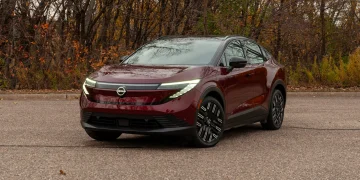


In the increasingly crowded electric vehicle (EV) market, the 2026 Nissan Leaf stands out as a testament to the brand’s commitment to providing affordable, efficient, and practical EV solutions. Starting at just over $30,000, the Leaf combines impressive range with modern features, making it an appealing option for those looking for a budget-friendly EV that doesn’t skimp on technology or performance. With a focus on value, range, and practicality, the Leaf emerges as a direct competitor to the Tesla Model 3, delivering on the promises that Tesla made years ago at a much more accessible price point.
A Bold Redesign: Sleek and Functional, Yet Distinctive
The 2026 Nissan Leaf represents a significant redesign from its previous iterations. While it retains the practicality and functionality that has made it a popular choice for EV buyers, it now offers a more refined, modern look that moves away from the quirky and sometimes divisive design of its predecessors. The exterior features smooth, flowing lines that provide a more contemporary appearance, while subtle nods to Nissan’s Z car heritage can be seen in the rear design. Although it’s not going to win any beauty contests, the Leaf’s design is distinct, offering a more appealing and cohesive look compared to its earlier, boxier models.
One unique design feature that stands out is the rear door handles integrated into the black trim near the C-pillar. This design, which some people may find controversial, harks back to the original hardbody Pathfinder from Nissan’s history. For fans of vintage design, it’s a thoughtful touch. However, the overall look is likely to be seen as functional and distinct, rather than striking or beautiful.
Inside, the Leaf adopts a more minimalist, modern interior compared to the spaceship-like aesthetic of its past. The dashboard now features horizontal screens, with a digital gauge cluster and a touchscreen equipped with wireless Apple CarPlay and Android Auto. The cabin includes thoughtful design details, such as cloth trim that evokes the spirit of the 1990s-era Z cars, setting it apart from other more expensive electric vehicles like the Hyundai Ioniq 5 or the Chevrolet Equinox EV. The top Platinum+ trim even offers an electrochromatic glass roof, allowing drivers to adjust the roof’s opacity at the touch of a button, something that higher-priced luxury vehicles like the Lucid Gravity and Cadillac Escalade IQ can’t offer.
Interior Space: Practical, but Not Spacious

While the Leaf’s cabin is fresh and modern, it isn’t without its compromises. The front seats offer comfort and support, but rear-seat passengers may feel cramped. Rear legroom and toe room are limited, and the rear seats aren’t as spacious as competitors like the Chevrolet Equinox EV. That said, the Leaf’s hatchback design provides a useful 20 cubic feet of cargo space, and with the rear seats folded down, that expands to a generous 55.5 cubic feet. However, the Leaf does not feature a front trunk (frunk), which could have been a nice touch for additional storage.
Powertrain and Driving Dynamics: Efficient and Responsive
The 2026 Nissan Leaf comes with a single motor that produces 214 horsepower and 261 lb-ft of torque, powered by a 75-kWh lithium-ion battery. While the Leaf is not designed to be a high-performance vehicle, its acceleration is quick enough, and the torque is available immediately, offering a responsive driving experience. The Leaf’s suspension system, featuring a new multilink setup at the rear, ensures that the car remains stable and composed when navigating corners. On rougher surfaces, such as the cold, broken pavement found in Minnesota, the Leaf’s ride quality remains comfortable, avoiding the harshness typically found in economy cars.
One feature that many drivers will appreciate is the one-pedal driving mode, made possible by the Leaf’s regenerative braking system. The regenerative braking levels can be adjusted using the wheel-mounted paddle shifters, allowing drivers to control the car’s deceleration without needing to press the brake pedal.
Range, Efficiency, and Charging
The 2026 Nissan Leaf delivers impressive range for an affordable EV, with the base S+ model offering an EPA-estimated range of up to 303 miles. This is a remarkable achievement for a car priced under $30,000. However, as you move up to higher trims like the SV+ and Platinum+, the range drops to 288 miles and 259 miles, respectively, reflecting the additional features and weight added to the vehicle. Even with these slight reductions, the Leaf remains an efficient and practical choice for daily driving.
During mixed suburban driving in cold Minnesota temperatures, the Leaf Platinum+ tested achieved an average efficiency of 3.0 miles/kWh, which is commendable for a vehicle in this class. Under more moderate conditions, the Leaf’s efficiency can improve further, as evidenced by the 3.8 miles/kWh recorded in warmer temperatures.
The Leaf also features dual charging ports: a J1772 port for Level 2 home charging and a Tesla-like NACS port for DC fast charging. The fast charging capability allows the Leaf to charge from 10% to 80% in just 35 minutes, with a peak charge rate of 150 kW. This makes the Leaf an excellent choice for drivers who need to recharge quickly during long trips.
Value for Money: A Strong Contender in the EV Market
With a base price of $31,485, the 2026 Nissan Leaf offers exceptional value for those looking for an affordable, efficient, and well-equipped electric vehicle. Even the base model comes with a host of standard features, including a surround-view camera system, adaptive cruise control, blind-spot monitoring, and a 12.3-inch digital gauge cluster, augmented by a 12.3-inch touchscreen. The top-spec Platinum+ trim costs $41,930, which includes features such as heated leather seats, a Bose audio system, and an electrochromatic glass roof.
However, as you move up to the more expensive trims, the value proposition diminishes slightly. The range drops as the price increases, and features like all-wheel drive—offered by competitors like the Chevy Equinox EV—are not available. Still, the base Leaf offers a compelling option for those seeking a practical, well-rounded EV at a reasonable price.
The Future of the Nissan Leaf
For buyers looking for an affordable, efficient, and well-rounded electric vehicle, the 2026 Nissan Leaf remains an excellent option. With its impressive range, modern design, and value-packed features, the Leaf is well-positioned to compete in a market dominated by more expensive EVs like the Tesla Model 3 and Model Y. Furthermore, the upcoming, even more affordable Leaf model will offer an even lower starting price of around $26,000, making it an even more attractive option for budget-conscious buyers.
In conclusion, the 2026 Nissan Leaf delivers on the promise of affordable EVs with a balance of practicality, efficiency, and value. It may not offer the performance or luxury of high-end EVs, but for many consumers, the Leaf represents an unbeatable value in the electric vehicle market.

