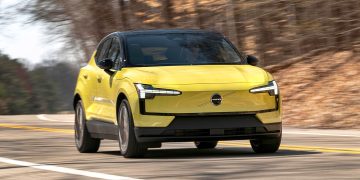


2025 Volvo EX30 Performance Copies Tesla’s Bad Habits
The Volvo EX30 Performance was introduced with big promises. Volvo pitched it as a budget-friendly EV for the masses. But the reality falls short. Instead of an affordable, long-range electric SUV, buyers get a premium-priced, short-range hot hatch—complete with Tesla-style quirks.
Tesla’s design influence is everywhere. The speedometer lives in the corner of the infotainment screen. The gear selector doubles as the cruise control. A credit-card-style backup key mimics Tesla’s minimalist style. The layout feels modern—but mostly because it hides cost-cutting decisions.
A Price Hike That Changed Everything
Volvo promised a $36,245 EV with a 275-mile range. What’s available now is a $46,195 twin-motor version that only reached 180 miles in real-world driving. That’s a big gap between hype and delivery. In fact, it mirrors Tesla’s own pattern of overpromising.
To Volvo’s credit, the Volvo EX30 Performance drives beautifully. It sprints from 0–60 mph in 3.2 seconds and offers 422 hp with 400 lb-ft of torque. Handling is smooth, civilized, and easy to control. Despite its speed, the EX30 isn’t aggressive. It feels more like a refined GTI than a riotous road rocket.
Read Also
- 2026 Lotus Emira Gets Better Tech and Higher Price Tag
- Porsche 911 Turbo S Hybrid to Debut by Year’s End
Performance in a Polished Package
Braking and cornering are respectable. The EX30 stops from 60 mph in 110 feet and pulls 0.87 g on the skidpad. That’s fine for an all-season tire setup on a 4,190-pound SUV. It’s not a sports car, and that’s exactly why it works. Volvo delivers a great daily-driving EV with balanced power and comfort.
But performance can’t distract from the reality: this was supposed to be a cheap EV.
Smart Interior on a Budget Platform
Inside, Volvo proves it can turn inexpensive materials into visual art. Clever use of textures and color elevates the cabin. The fit and finish feel premium, even if the components aren’t. The design choices are bold. For instance, the glovebox is placed in the center of the dashboard to make more room for the passenger.
Instead of a traditional center console, there’s a sliding bin with an adjustable top plate. The driver and front passenger share two window switches located in the center console, controlling all four windows. And a single soundbar replaces traditional door-mounted speakers—affecting sound quality but saving space and wiring.
In a $36K EV, these trade-offs might feel justified. At nearly $48,000, they’re harder to accept.
Range and Charging Disappoint
Where the Volvo EX30 Performance truly stumbles is in its range and charging. The 64.0-kWh battery falls behind rivals. Although it’s officially rated for 253 miles, real-world testing at 70 mph only yielded 180 miles. That’s one of the worst results in the MotorTrend Road-Trip Range test, and a 29% gap from its rated range.
Charging speeds are also underwhelming. The EX30 peaks at 153 kW but quickly drops. In 15 minutes, it adds just enough range for 87 highway miles. That’s far behind top rivals like the Hyundai Ioniq 5 or Tesla Model Y.
Tech-Heavy But Controlled
Volvo has embraced the minimalist dashboard approach. Most functions run through a 12.3-inch Android Automotive touchscreen, similar to what’s found in the larger EX90. Fortunately, this smaller system performs better. You can download Spotify, Waze, and more, and it still supports Apple CarPlay and Android Auto.
Two trims are offered: Plus and Ultra. The $1,700 Ultra trim adds safety and luxury features, like Pilot Assist. It keeps the car centered, manages speed, and can initiate lane changes—but only under supervision. Compared to Ford BlueCruise or GM Super Cruise, Pilot Assist feels limited.
Conclusion: A Missed Opportunity in Disguise
The Volvo EX30 Performance excels in design and acceleration. It’s fast, fun, and thoughtfully styled. But the EV that was supposed to be a breakthrough in affordability now sits in luxury territory—with less range, less space, and average charging.
If Volvo ever brings the single-motor base model to the U.S., it might finally meet its original value promise. Until then, buyers looking for range and road-trip capability may find better value in other EVs around the same price.

